
How to start Onion Farming | Complete Quick Guide
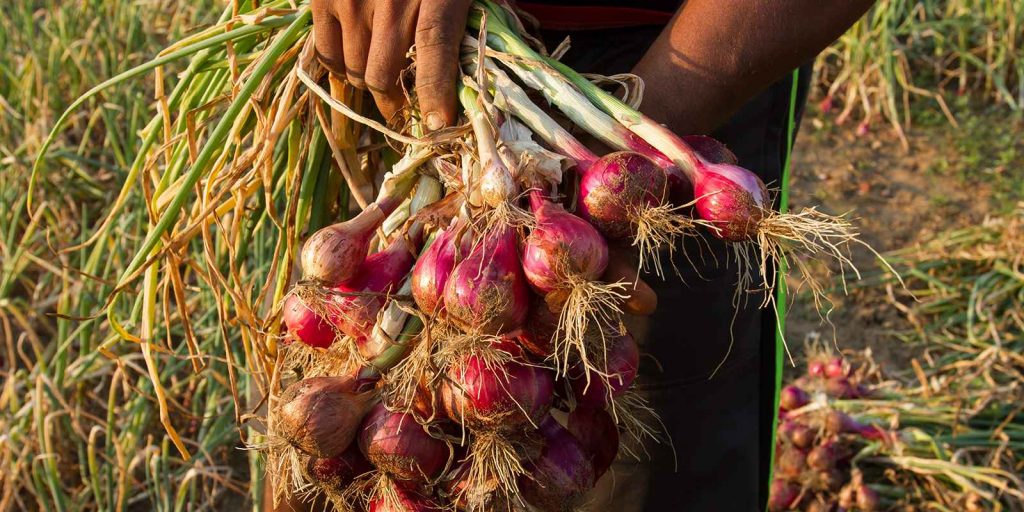
Onion is very sensitive crop as like many other sensitive crops. Before planning for onion farming you should consider the following factors which will be beneficial for greater production. We are trying to describe the onion growing procedure step by step.
Here is a short overview of whole cultivation method:
There are several things you should consider before start onion farming. i.e. The Climate/weather and temperature, soil condition, choosing a place of onion cultivation.
After stabilizing the perfect setup you have to plant onion in the field. With fertilizers depending on your soil and crop demands. Organic fertilizer is a great choice here.
The next step will be caring. Cultivating vegetables and herbs is easy as well as demanding. But a good care can ensure better production which requires better knowledge about the crop demands. We share a standard guideline for onion farmers.
Fertilizing the plant and control pests disease is sometimes a challenge for onions cultivator. So be careful in this stages.
Finally, Harvesting it from the field and storing them in an appropriate way.
Right now, There may be a lot of questions in your mind. Starting with how to and when to. Let’s find those answers below.
Choosing Best Type of Onion Varieties:
There are a lot of varieties of onion. Some are incredibly big (nearly .5kg) and some are small( 50 gram). Now the question is which one you should for your onion farm.
You have to choose varieties depending on the season. And how much sunlight you can get in that period of time. Based on the sunlight availability we can divide them into three main categories. Let’s learn about those three categories and the best varieties:
Short-day onions:
Grows where 10-12 hours of sunlight. Suitable for winter seasons.
Varieties: Georgia Sweet, Sweet Red, Granex, Red Creole, Red Burgandy, White Bermuda, Vidalia, and Southern Belle, Texas Super Sweet, Texas Sweet White etc.
Intermediate-day onions:
This types can grow in any season and requires 12-14 hour of sunlight.
Varieties: Cabernet, Candy Onion, Red candy apple etc.
Long-day onions:
It requires 14-16 hour of sunlight. Thrives well in summer. The best varieties are Alisa crag, White sweet Spanish, Copra, Walla Walla Sweet, Paterson, Yellow Sweet Spanish etc.
Best Season and weather for farming onion:
- Since every crop is depending on the cultivation season. Onion bulbs are planted in the cool season and usually cultivated during the late winter season and harvested just before the summer begin.
- If you want to grow onion from seeds, the session starts from the spring season. It requires some extra days to mature.
- The transplanting of the seedlings occurs in between mid to late spring.
The ideal temperature for onion farming is in between 13-25°C (55-75°F) for Asia and between 8°C – 30°C (46°F-86°F.) for two America.
Unfortunately, onion does not grow well in places with heavy snow or heavy rainfall. Though you can try to grow ginger indoor or when the temperature is in between 13-25°C.
So you should sow or transplant onion at the beginning of the winter season.
Best Soil condition & Preparing it for onion farming:
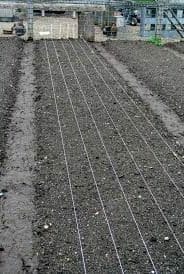
Before you planting onion you should learn about the best soil condition and other relevant factors which affect onion farming.
Red loam and sandy loam are highly preferable for onion farming. No matter if you don’t have those types as a soil. Scientifically you can improve your soil by using organic materials. Though it is not recommended in most of the cases. In fact, we do not suggest to do so.
Onions are mostly grown in any soil but the soil should be loose, well-drained, and should have plenty of nitrogen.
Now, determine the soil condition measure the pH and other soil nutrients. The ideal range of soil pH for growing best onion is in between 5.5 and 6.5.
Requirements for the Onion cultivations:
The other factors which can affect the production along with soil are:-
- You should consider the area of onion farming before you planted onion. Onions should be planted in a shiny place. Choosing a sunny area where your onion plants are won’t be shaded is beneficial for your plants.
- The cultivation process of onion is more or less same for all types of onion. Though different varieties require the different type of soil and fertilization.
- Read the instruction manual provided with seeds. Or contact nearest govt. agricultural help point.
Tools and equipment:
All of those tools are not required for every farmers or farm. The modern onion farming tools are:-
- Rollers,
- Bearings,
- Belted Chain Sprockets,
- Onion harvester,
- Weeding tools, etc
Methods of planting onion:
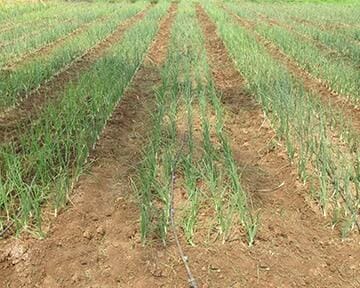
There exist a wide range of variations of onion, depending on their shape, size, and color.
Generally, Red, yellow and white are the three groups of onion widely cultivated across the world.
But luckily, there are three methods of planting onion you may apply transplants, sets, or seeds.
Planting Onion sets [onion bulb] into bed:
A less popular alternative to direct seeding is planting sets. Sets are a little onion bulb that is planted rather than seed to produce a mature bulb. Sets are immature bulbs turn the earlier year and offer the most farmers choices.
They are the simplest to plant, the shortest time to harvest, and the limited complication of the disease. However, they are more prone to bolting than seedlings or transplants. Roughly 15 years back, business cultivators tried different things with using sets and observed direct seeding to be more successful.
Planting Onion SETS in to field:
- Seedlings have different diameters, so sort seedlings by size before planting.
- Plant the bigger seedlings set together only 2 inches apart and the small at close spacing.
Transplants:
Transplants, which are seedlings begun in the current maturing season and sold in groups, are available in nurseries or other marketplaces.
They usually frame good quality bulbs within a short period of time (60 days or less). They are subject to diseases. Farmers Choice is slightly limited in that case. So this is suggested for quick growing.
Grow onion from Seeds:
Farming onions from seeds allow a great benefit of a wide choice in cultivars. The main difficulty of starting from seeds is, it will take up to 4 months to mature your crop. In cold areas, the farmer will need to begin their onion seedlings in indoors. Otherwise outdoor.
Seed Sowing method in Indoor:
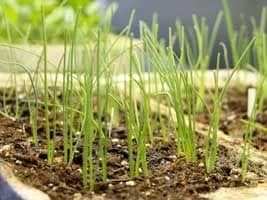
Remarkably tiny seed such as pelleted grain requires being sown inside.
- Use 4- x 6-inch containers and filled with a seed starting mix mostly compost [60-80%] near to the top.
- For sowing seeds, place the seeds straight on the soil surface
- Moreover, light aids in the germination so do not cover with soil.
- The seed starting mix moist need to keep a warm and moist place.
- The ideal warmth to grow seedling from maximum seeds is around 68-72 degrees F.
- It will take 2 weeks approximately to sprout seedling.
Seed Sowing method in outdoor:
Larger Medium seed/ grains require being sown on the outside.
- Sow the seed in two rows, about a 1/4- to 1/2-inch deep.
- Water them properly, put shade if necessary.
Transplants of seedlings
- Plant the seedlings in mid to late spring.
- Seed must be planted in the row,4 to 6 inches apart.
- 1 to 2 feet distance should maintain between any two.
- After, cut the tips to approximately 4 inches and put them about 1/2 inch below the surface.
- An organic buffer line of 30-50 cm can be introduced after several rows to ensure healthy crops.
Care for onion the plants:
A proper management of watering & fertilization gives you double production. As onion is a very sensitive plant. It requires frequent treatments of fertilizer.
Onion also farms with different crops like ginger, tomato. After cultivating ginger you can Grow baby corn.
- In supplement of fertilizer, onions require moist, weed-free soil with a pH level between 5.5 and 6.68 which we talk earlier.
- To get best results, the first application of fertilizer should be about three weeks after planting and then continue with applying every 2 to 3 weeks.
- When the neck starts feeling soft, stop apply any more fertilizer. This should occur nearly 4 weeks earlier to harvest.
- You must be watering after feeding and maintain moisture as early as you can during the growing season.
- Onions roots are vulnerable to moisture. So they need a steady watering process to thrive without problems.
- The closer to harvest time the more water will require for onion.
- The farmer who lives in the area with limited sunlight should grow short-day varieties, while long-day varieties seeds for whore live in areas where sunlight is abundant.
Each onions need about 1 inch of water per week.
Pest and Disease Controlling Methods of Onion farming:
Onions are more sensorial to insects, weeds, and diseases than other vegetable crops. Every one generally expects a disease-and insect-free crop.
- But the maggots are the one possible pest of onion. It’s 1/3-inch-long white, legless worms that move in a line from one bulb to the next and make hole upwards to feed on the stems.
To overcome the excessive damage, scatter-plant onions throughout the field. It will discourage the adult flies from setting their eggs at the roots of the plants if you put a thin layer of sand around onion bulbs.
- There may be a chance to affect scarcely visible onion thrips during hot, dry weather. It causes damaged plants with shiny spots on the leaves.
Thrips overwinter in weeds, maintaining the garden clear. Help you to reduce insect populations. Covering a studious mulch, such as aluminum flake, among rows may be the efficient way to deflect the thrips. The early you can discover that problem, you can spray bulbs with Beauveria bassiana or spinosad to combat thrips.
- A disorder called smut makes swelling up or hardening of leaves just about the neck, which ultimately blasts and drops dusty black spots over the plant. In the middle of the summer during warm, humid weather downy mildew, a purplish mold, shows up.
- Onions are moreover subject to pink root, it makes roots turn different colors and after that shrink, and neck spoilt, due to this reason tissues become hard and black crust.
All these issues are made by fungi in the soil and can be eliminated by rotating crops and by working humus within the onion bed to accommodate good drainage.
Harvesting Tips [When & how to]:
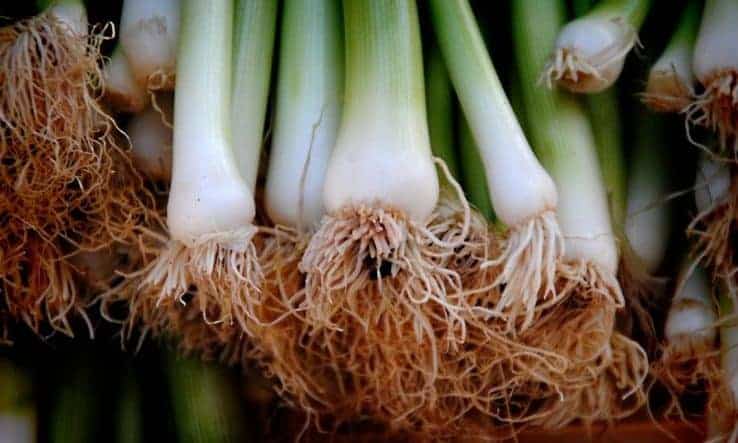
If you harvest young onion just pull them up few weeks after plantation if you want them to use as “spring onion” or “scallions” as there is no ideal measurement, just pull them up when they are big enough to suit you.
- When the onion tops turn in to yellow it means it is matured enough to harvest.
- Use a garden fork to pull them up early in the morning on a sunny day, loosen the soil and lay them a dry airy location for two days and always handle them very carefully.
- To avoid sunscald, lay the tops of one row over the bulbs of another.
- Once the onions are completely dry, cut back the tops to one inch. Now they are ready to eat.
Storing Onions
To store onions select a cool, dry, well-ventilated location, such as a garage or cellar. The ideal temperature for storing onion is at 40 to 50 degrees F.
- When the outer skins are completely dry, clean soil and release the tops.
- Place them in mesh bags to allow airflow.
- Periodically check for any spoiled onions, and remove them to avoid deterioration of the others.
- Usually, sweeter onions can’t store as long as more pungent ones, so use the sweeter onions first.
This is not the end of onion farming, there are lots more to explore about onion farming, to know the different methods of onion plantation, or the business plan of onion farming, the unique technique of onion cultivation, and more stay tuned with us.

Find a phone number owner
November 8, 2023 at 8:35 PMI admire how you simplify complex concepts into easily understood pieces of knowledge. Well done!